


Pool Pump Repair in Phoenix: 7 Common Failures and Solutions
When your pool pump stops working in the middle of a Phoenix summer, the clock starts fast. Here’s how to spot the issue, what you can check safely, and when to call a professional.
It’s 113° outside, you walked past the pool equipment pad, and something’s off — no hum, a weird grinding noise, water pooling around the base, or the pump just won’t catch prime. In Phoenix, a pool pump that stops working in July isn’t an inconvenience. Within 48 hours your water can turn green, algae can set in, and what should have been a simple repair can become a bigger cleanup and chemistry reset.
The good news: most pool pump repair issues we see at Iconic Pools & Spas fall into seven buckets. Some can be diagnosed in five minutes from your patio. Others need a technician. Here’s how to tell which is which.
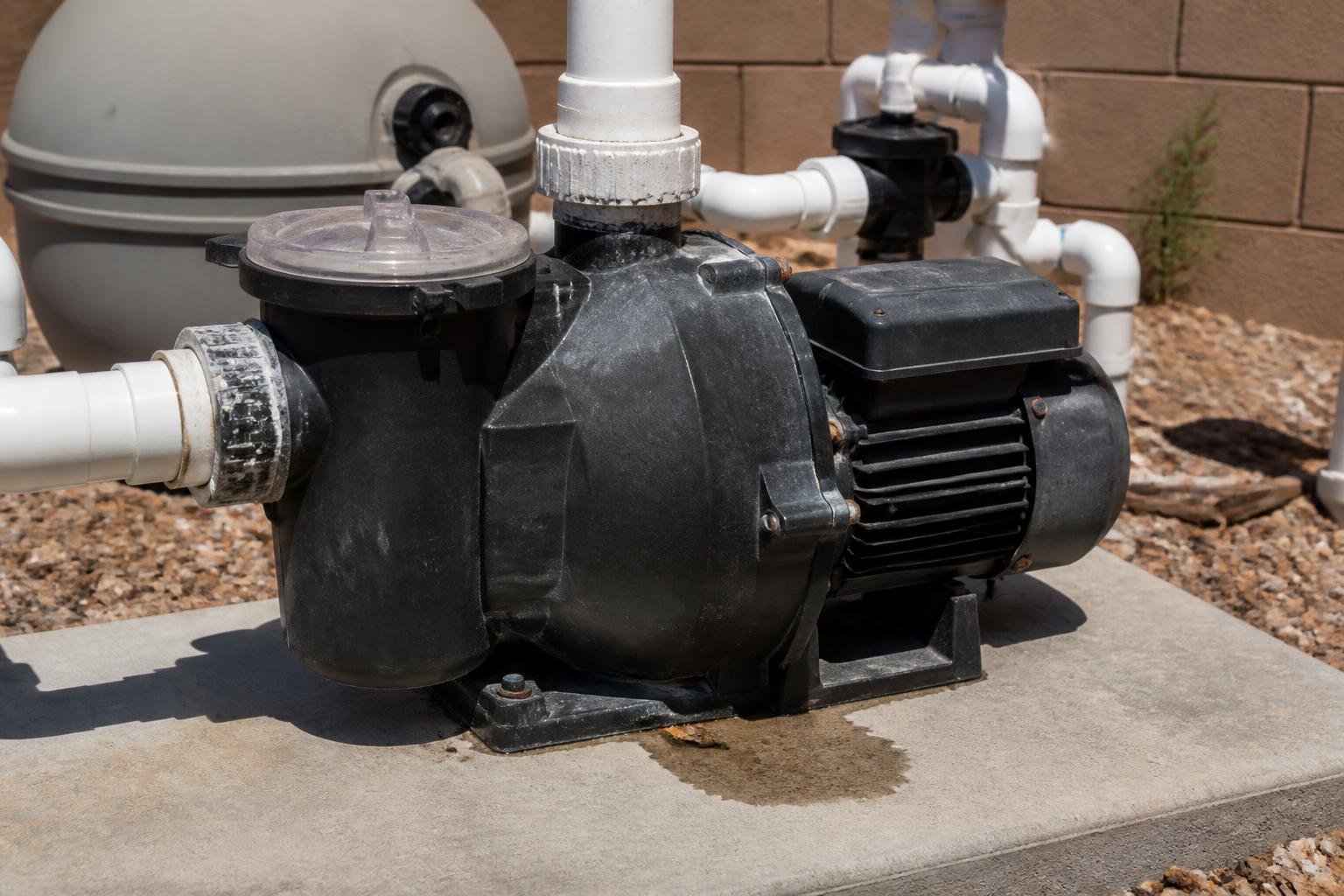
Why Phoenix Summers Are So Hard on Pool Pumps
Before we get into the symptoms, it helps to understand why this happens so often here. Phoenix pool equipment lives a harder life than equipment almost anywhere else in the country.
- Heat soak: Ambient air at the equipment pad can regularly hit 115°+. Motor windings rated for continuous duty at 104° run hotter, age faster, and fail sooner.
- Hard water: Valley water is loaded with calcium. Scale builds up inside impellers, seals, and salt cells, restricting flow and stressing the motor.
- Monsoon debris: July and August storms dump dust, palm fronds, and grit into the skimmer, which can clog the pump basket and starve the pump of water.
- Long run times: To keep up with evaporation and chlorine demand, most Phoenix pumps run 8–12 hours a day in summer.
Add it all up and the average Phoenix pool pump lasts 6–8 years instead of the 10–12 years you might see in a milder climate. Knowing what to watch for can help you protect the system and avoid bigger repair costs.
"In Phoenix, a pool pump problem gets expensive fast. The earlier you catch the symptom, the more options you usually have."
— Iconic Pools & Spas
7 Common Pool Pump Failures in Phoenix
The Pump Won’t Turn On at All
What you’ll notice: Total silence at the pad. No hum, no click, nothing.
The most common causes include a tripped GFCI or breaker, a timer or automation schedule set wrong after a power outage, a failed capacitor, or a burned-out motor. Start with the sub-panel first. It’s free and takes about 30 seconds.
A capacitor is usually a lower-cost repair for a technician. A motor replacement is more expensive. If your pump is more than seven years old and the motor is shot, this is the moment to consider a variable-speed upgrade.
The Pump Won’t Prime
What you’ll notice: The motor runs, but the pump basket stays empty or only partly fills. No water moves through the system.
Likely causes include low pool water level, a clogged skimmer basket, a clogged pump basket, a cracked pump lid, a bad lid O-ring, a suction-side plumbing leak, or a closed or stuck valve.
Start at the pool. Make sure the water is above the bottom of the skimmer opening. Then empty both baskets and inspect the pump lid O-ring. If the pump still won’t hold prime, you likely have a suction-side air leak that needs professional diagnosis.
The Pump Is Overheating or Shutting Itself Off
What you’ll notice: The pump runs for an hour or two, then shuts down. It may come back on later or after you reset the breaker. The housing may feel hot to the touch.
This is one of the most common July pool repair calls in Phoenix. The motor has a thermal overload built in. When it gets too hot, it shuts down to protect itself.
Common causes include restricted flow, a dirty filter, clogged baskets, closed valves, no shade or airflow at the equipment pad, bad bearings, or a failing capacitor. Clean the filter and baskets first. If your pad gets blasted by afternoon sun, use a vented shade cover. Never wrap or seal off a pump with no airflow.
The Pump Is Leaking
What you’ll notice: A wet spot under the pump, dripping near the shaft seal area, or a slow puddle that comes back after you dry the pad.
The most common cause is a worn shaft seal. Other possibilities include a cracked pump housing, a bad lid O-ring, a cracked diffuser, or worn gaskets.
A shaft seal is an inexpensive part, but it is a real repair. The pump has to be opened, the motor pulled from the wet end, and the seal installed correctly. If water has been leaking onto the motor for a while, the bearings may already be damaged.
The Pool Isn’t Circulating Even Though the Pump Is Running
What you’ll notice: The pump sounds normal, but the return jets are weak or dead. Filter pressure may be unusually low.
Likely causes include a clogged impeller, closed or partially closed valves, an air lock in the line, or a worn impeller that is no longer moving water efficiently.
Turn the pump off and shut off the breaker before inspecting anything. You can remove the pump basket and look into the impeller eye with a flashlight. Hair, leaves, debris, and calcium scale can all jam the impeller. Calcium scale inside the impeller is especially common in Phoenix.
Filter Pressure Is High or Climbing Fast
What you’ll notice: The pressure gauge reads 8–10 psi higher than your clean baseline.
This is not always a pump problem, but it puts the pump under serious strain. Causes include a dirty filter, filter media at the end of its life, torn DE grids, packed cartridges, old sand, or a closed return-side valve.
If you backwash or clean the cartridges and pressure drops back to normal, you’re likely fine. If pressure climbs again within days, the filter media may be failing. Running a pump against a clogged filter all summer is one of the fastest ways to cook the motor.
The Pump Is Making a New, Bad Noise
What you’ll notice: Grinding, screeching, rattling, a high-pitched whine, or a sound like marbles or gravel that was not there last month.
Grinding or screeching usually points to bad motor bearings. Rattling may mean debris in the impeller or a loose motor mount. A gravel-like cavitation sound usually means the pump is starving for water. A loud hum with no spin often points back to the capacitor.
Bearings rarely get better. Once the noise starts, you may have weeks to a few months before the motor seizes. Address it before the failure damages more of the system.
When to Repair vs. When to Replace
The honest rule of thumb in Phoenix is simple: the older the pump, the more sense it makes to price replacement instead of putting money into another major repair.
| Situation | What We Usually Recommend |
|---|---|
| Pump is under 5 years old | Repair it when the issue is isolated and the rest of the system is in good shape. |
| Pump is 5–7 years old and single-speed | Repair if it’s a minor fix. Replace with variable-speed if it’s a major repair. |
| Pump is 7+ years old | Replace it in most cases, especially if the motor, housing, or bearings are failing. |
| Single-speed pump of any age | Get a quote on a variable-speed pump for efficiency, quieter operation, and lower long-term energy use. |
A note on variable-speed pumps: They cost more upfront, but they can cut pool pump electricity use by 50–80%. For many Phoenix homeowners running long summer schedules, that can mean meaningful monthly savings and a smoother-running system.
What You Can Check Yourself
Some pool pump issues are safe and simple to inspect before calling a professional. Others should not be touched unless you have the training and tools to do the work correctly.
| You Can Usually Handle | Call a Pro For |
|---|---|
| Cleaning skimmer and pump baskets | Anything electrical beyond a breaker reset |
| Cleaning or backwashing filters | Replacing capacitors or motors |
| Resetting breakers and timers | Diagnosing suction-side air leaks |
| Replacing the pump lid O-ring | Replacing a shaft seal |
| Checking pool water level | Cracked housing, major leaks, or recurring shutdowns |
Iconic Pools & Spas runs pool equipment repair across the Valley, including Phoenix, Scottsdale, Chandler, Gilbert, Mesa, Queen Creek, and San Tan Valley. We carry common pump parts on the truck, so many repairs can be completed in one visit.
Frequently Asked Questions
Why is my pool pump not working all of a sudden?
The three most common causes are a tripped breaker or GFCI, a clogged pump or skimmer basket starving the pump of water, or a failed start capacitor. Check those in order before assuming the worst.
Why is my pool pump humming but not working?
A hum with no motor spin often means a failed start capacitor. Do not let the pump continue running in that state for more than a few minutes because it can burn out the motor windings.
How long should a pool pump last in Phoenix?
Six to eight years is typical in Phoenix, compared with 10–12 years in milder climates. Heat, hard water, long summer run times, and poor airflow at the equipment pad can all shorten pump life.
How much does pool pump repair cost in Phoenix?
Costs depend on the failure. A capacitor replacement may be one of the lower-cost repairs, while shaft seal, motor, or full pump replacement will cost more. Iconic Pools & Spas provides clear quotes before repair work starts. You can contact the team for current pricing.
Can I run my pool pump less to save it?
Cutting run time below what your pool needs is usually false economy. You may trade a pump issue for algae, cloudy water, or chemistry problems. A better solution is often a variable-speed pump running longer hours at lower RPM.
My pool pump is overheating in summer. What should I do?
Clean the filter and baskets first to make sure the pump is not fighting a restriction. Then check that the equipment pad has airflow and some afternoon shade. Use vented shade only. If the pump still overheats, the motor bearings or capacitor may be failing.
Need Pool Pump Repair in Phoenix?
Iconic Pools & Spas is a family-owned pool service, repair, and remodel company serving the Phoenix metro and East Valley. From pool pumps and filters to heaters, automation, leaks, and circulation issues, our team provides honest diagnostics and reliable repair solutions.
Schedule Pool Repair


Comments are closed